
Harper YU
Harper YU
UX · Product Design · Case Study
Depinsim
Turning mobile data from a cost into a reward
Depinsim
DePINSIM is a mobile connectivity app where users earn real mobile data through daily activity — tapping, completing tasks, and travelling. I led product design across a cross-functional team, shaping the experience from a Telegram mini app to a multi-platform ecosystem that reached 1.2M monthly active users and raised $1M in funding.
Product designer
May 2024 – Jan 2026
Telegram · iOS / Android
1.2M MAU
Project
Overview
Built from 0 to 1. Then upgraded.
The constraint
The real challenge wasn't technical — it was human. How do you make a product built on a complex decentralised protocol feel like something a traveller installs at the airport, not something a crypto developer configures on a weekend.
Timeline
May 2024 — V1 launched on Telegram.
Aug 2024 — V2 added engagement loops, partner campaigns, and a VIP system — extending compatibility to Line mini app and native app.
Problems to
solve for V1
What research told us to design for
Four problems, drawn directly from the persona, competitor gap, and storyboard above — each one a question the first version had to answer.
Pain Points
01
A crypto earn mechanic needs to be understood instantly
Sofia doesn't know what "mined data" means. Whatever the first interaction is, it has to teach the loop without requiring the user to read anything first.
02
Earned rewards risk becoming abstract Web3 points that never resolve into anything real
Most Web3 products reward users with points or tokens that stay abstract — numbers that accumulate but never convert into something tangible. If DePINSIM's earn mechanics follow that pattern, the product inherits Web3's core trust problem: rewards that don't mean anything.
03
Travel needs to feel like more than a number
The storyboard's core scenario is a traveller crossing borders. A distance counter doesn't capture that — the product needed to make movement itself feel rewarding.
04
A working eSIM doesn't activate itself
The eSIM delivers real value once turned on — but with no usage history yet, there's nothing pulling a user toward that first tap. Whatever drives activation has to create urgency where none exists naturally.
05
Growth couldn't rely on DePINSIM's budget alone
Acquiring users at scale meant funding rewards for every action — but a single company's budget caps how fast that can grow. The product needed a way to let outside money drive user growth without becoming an ad platform.
V1 Design
decisions
Five decisions that shaped Version 1
Each one answered a specific design question before we had real usage data.
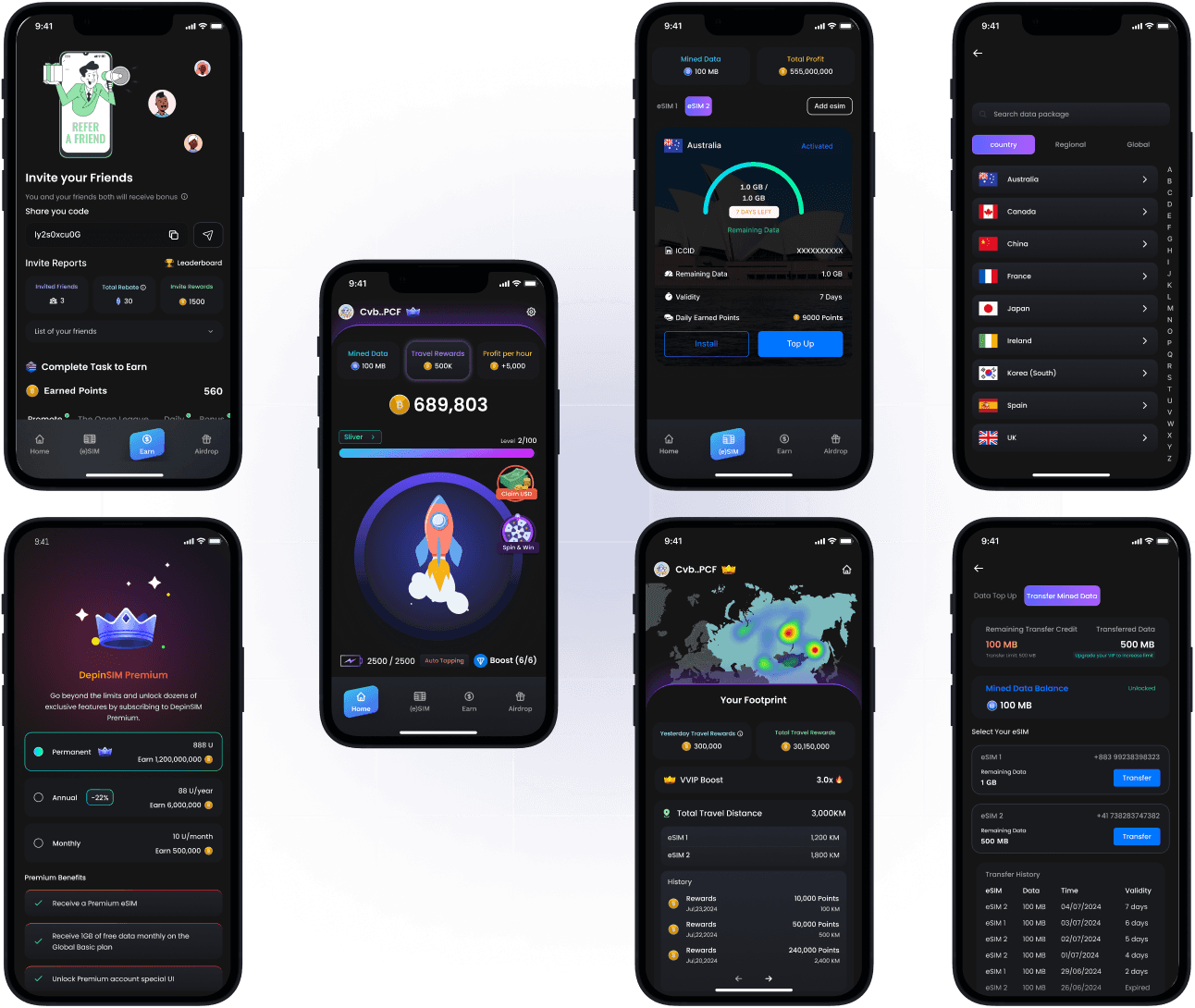
Decision 01 — First-second engagement
First-second engagement
Chose
Tap → animation → "+1" — reward felt before it's understood. Zero reading required.
Rejected
Static dashboard with a text explanation of how earning works
Three psychological principles: Variable ratio reinforcement (small immediate rewards produce highest response rate). Sub-100ms feedback (tap feels like it caused the reward). Endowment effect (points earned through action valued 2–3× more than points given).
DECISION 02 — ACTIVATION CONVERSION
MAKE WAITING FEEL LIKE LOSING PROFIT, NOT JUST DELAYING
Chose
A concrete pending-earnings number tied to the dormant state — turns waiting into a visible, quantified loss.
Rejected
A generic "Activate your eSIM" CTA — accurate, but a flat command with no emotional cost attached to ignoring it.
The number persuades, not the copy: Same principle behind Duolingo's streak-loss alerts and Robinhood's "portfolio missed X% today" — both turn a possibility into a felt absence.

Data Top Up
Transfer Mined Data
Remaining Transfer Credit
Transferred Data
100 MB
500 MB
Transfer Limit: 500 MB
Upgrade your VIP to Increase limit
Mined Data Balance
Unlocked

100 MB
Select Your eSIM
eSIM 1
+883 99238398323
Remaining Data
1 GB
Transfer
eSIM 2
+41 738283747382
Remaining Data
500 MB
Transfer
Transfer history
eSIM
eSIM 2
eSIM 1
eSIM 2
eSIM 2
eSIM 1
eSIM 2
Data
100 MB
100 MB
100 MB
100 MB
100 MB
100 MB
Time
04/07/2024
03/07/2024
02/07/2024
01/07/2024
29/06/2024
26/06/2024
Validity
7 days
6 days
5 days
4 days
2 days
Expired
Decision 03 — Earn to real data
Mined Data converts to real data. Everything else builds toward it
Chose
One mechanic that converts directly into real data — solving Web3's rewards-that-never-become-anything problem.
Rejected
Abstract points for every mechanic, like most Web3 apps — numbers that never resolve into something usable.
The limit is a side effect, not the point: It's capped because it's real, finite value — not an arbitrary number. The VIP prompt follows from that scarcity.

Your Footprint
Yesterday Travel Rewards

300,000
Total Travel Rewards
30,150,000

VVIP Boost
3.0x 🔥
Total Travel Distance
3,000KM
eSIM 1
1,200 KM
eSIM 2
1,800 KM
History

Rewards
Jul,23,2024
10,000 Points
100 KM
Rewards
Jul,22,2024
50,000 Points
500 KM
Rewards
Jul,20,2024
240,000 Points
2,400 KM
Total Countries Lit Up
4
Germany
19/07/2024
UK
13-17/07/2024
Earned Rewards

15,000
South Korea
09-15/06/2024
Earned Rewards
15,000
France
20-30/05/2024
Earned Rewards
15,000

Cvb..PCF

Decision 04 — Travel rewards
A heatmap turns travel history into personal identity, not a distance counter
Chose
Heatmap world map + country list — spatial identity that grows with every journey
Rejected
Raw distance table (eSIM 1: 20km, eSIM 2: 80km) — accurate, no emotional resonance
The multiplier is the VIP argument: non-VIP sees 1.0x next to "Become a VIP." VVIP sees 3.0x 🔥. The map makes upgrading feel like unlocking a better version of your own footprint.
DECISION 05 — TASK ECONOMY
THE TASK LIST IS A TWO-SIDED MARKETPLACE, NOT A TO-DO LIST
Chose
Tasks as a sellable surface — partners fund the reward, DePINSIM provides the audience
Rejected
Internal-only tasks — caps growth at whatever DePINSIM itself can fund
One interaction, two success metrics: Users need it to feel like a reward. Partners need it to function like a tracked conversion. The task format had to satisfy both without either side compromising.
results after 3 months
1.2M
Monthly active users
10K+
eSIM activations
$50K+
Revenue from data sales
10+
Enterprise integrations
Fast growth👏🏻 👏🏻 ! But ⚠️ the ~0.8% activation rate (10K installs from 1.2M users) revealed that most users arrived, earned a bit, and left without converting. The task list was completable in one session — and after that, there was nothing designed to bring them back.
Problems to solve for V1
What the data and users told us
Real usage revealed gaps that research alone couldn't have predicted.
01
Passive earnings went unnoticed without any prompt to check them
The eSIM kept mining even when users were away, but nothing surfaced what had accumulated. Users simply forgot the passive income existed — a mechanic built to reward absence only works if something brings them back to look.
02
Growth was self-contained, with no connection to the wider Web3 ecosystem
DePINSIM had no presence in other projects' user bases, and no other project had a presence in DePINSIM. Every new user came through DePINSIM's own channels — there was no mechanism to exchange traffic with partners who had audiences of their own.
03
VIP subscriptions underperformed despite being the product's key revenue line
VIP is the primary revenue stream beyond data sales, but subscription numbers fell short of target. The product wasn't short on people who could convert — it was short on moments inside the app that made VIP visible enough to consider.
Research
What we knew before building
User feedback, competitor analysis, and early product flow testing shaped three insights that directly changed what got designed.


User Personas
Travellers, remote workers, and Web3 enthusiasts who need seamless cross-border connectivity and a simple way to earn and redeem mobile data rewards.


Competitor Analysis
Most competitors focus on either global eSIM access or Web3 incentives — few connect connectivity, rewards, data utility, and gamified engagement into one continuous experience.
Make mobile data accessible, earnable, useful, and engaging.
From research to direction

Storyboard
The storyboard centred on frequent travellers needing affordable cross-border data — someone who wants to activate an eSIM instantly without swapping physical SIMs, earn rewards through participation, and convert those rewards into real mobile data. This reframed the entry point: the product had to answer "can I use this now?" before "what is DePIN?"

App map
Mapping the protocol's layers — eSIM, rewards, tasks, mined data, campaigns, wallet, profile — onto five branches (Earn / eSIM / Market / Airdrop / Profile) showed where the complexity could live without surfacing the underlying protocol to the user. This became the four-tab navigation that shipped in V1.
Here we are Version 2
Three decisions that changed the product
Each one answers a problem found after V1.
Offline earnings keep growing — but only a return trip unlocks them
Chose
Passive accumulation + manual claim — idle time becomes a growing reason to return
Rejected
Silent background sync — no signal that anything had built up
The claim is the point: Silent earnings give no reason to open the app sooner. Making the user return to claim what's theirs turns a balance update into a re-engagement trigger.
Trade exposure with partners instead of buying users
Chose
Traffic exchange with external partners — mutual exposure funds growth on both sides without new ad spend.
Rejected
Reliance on DePINSIM's own channels — growth capped at whatever the team could fund and promote directly.
The exchange has to work for both parties' numbers, not just DePINSIM's:A traffic swap only continues if both sides can point to real user growth from it — which is why this became a repeatable mechanism, not a one-off campaign.
Every upgrade moment already had room for one more
Chose
Contextual prompts next to existing upgrade moments, linking to the VIP page — give users a reason to click, not a new destination.
Rejected
Leaving VIP as a page only reachable through settings — present, but nothing ever pointed there.
The page didn't change. The reasons to visit it did.
Design Process
What we knew before building
User feedback, competitor analysis, and early product flow testing shaped three insights that directly changed what got designed.
User Personas
Travellers, remote workers, and Web3 enthusiasts who need seamless cross-border connectivity and a simple way to earn and redeem mobile data rewards.
Competitor Analysis
Most competitors focus on either global eSIM access or Web3 incentives — few connect connectivity, rewards, data utility, and gamified engagement into one continuous experience.
Make mobile data accessible, earnable, useful, and engaging.
From research to direction
Storyboard
The storyboard centred on frequent travellers needing affordable cross-border data — someone who wants to activate an eSIM instantly without swapping physical SIMs, earn rewards through participation, and convert those rewards into real mobile data. This reframed the entry point: the product had to answer "can I use this now?" before "what is DePIN?"
App map
Mapping the protocol's layers — eSIM, rewards, tasks, mined data, campaigns, wallet, profile — onto five branches (Earn / eSIM / Market / Airdrop / Profile) showed where the complexity could live without surfacing the underlying protocol to the user. This became the four-tab navigation that shipped in V1.
The product existed in the real world


Rollup banners
Designed to work in dark conference environments — high contrast, product screens readable at 2m.
Physical SIM packaging
Dark background, space-themed visual language consistent with the app. The product's first tangible touchpoint.
Business cards + merch
Logo-first, minimal copy. The same visual language carried from app to object.
Related Projects


UX · Product Design · Case Study
Depinsim
Turning mobile data from a cost into a reward
Depinsim
DePINSIM is a mobile connectivity app where users earn real mobile data through daily activity. I led product design across a cross-functional team, shaping the experience from a Telegram mini app to a multi-platform ecosystem that reached 1.2M monthly active users and raised $1M in funding.
Product designer
May 2024 – Jan 2026
Telegram · iOS / Android
1.2M MAU
Turning mobile data from a cost into a reward
Depinsim
DePINSIM is a mobile connectivity app where users earn real mobile data through daily activity. I led product design across a cross-functional team, shaping the experience from a Telegram mini app to a multi-platform ecosystem that reached 1.2M monthly active users and raised $1M in funding.
Product designer
May 2024 – Jan 2026
Telegram · iOS / Android
1.2M MAU
Project
Overview
Project Overview
Built from 0 to 1. Then upgraded.
The constraint
How to make a product built on a complex decentralised protocol feel like something a traveller installs at the airport, not something a crypto developer configures on a weekend.
Timeline
May 2024 — V1 launched on Telegram.
Aug 2024 — V2 upgraded, extending compatibility to Line mini app and native app.
Problems to
solve for V1
What research told us to design for
Four problems, drawn directly from the persona, competitor gap, and storyboard above — each one a question the first version had to answer.
Pain Points
01
A crypto earn mechanic needs to be understood instantly
Sofia doesn't know what "mined data" means. Whatever the first interaction is, it has to teach the loop without requiring the user to read anything first.
02
Rewards can't feel like fake points
Most Web3 apps reward you with numbers that never become anything. We couldn't repeat that.
03
Travel needs to feel like more than a number
The storyboard's core scenario is a traveller crossing borders. A distance counter doesn't capture that — the product needed to make movement itself feel rewarding.
04
A working eSIM doesn't activate itself
With no usage history yet, nothing pulls a new user toward that first tap.
05
Growth can't run on our budget alone
Acquiring users at scale meant funding rewards for every action. The product needed a way to let outside money drive user growth without becoming an ad platform.
V1 Design
decisions
Five decisions that shaped Version 1
Each one answered a specific design question before we had real usage data.
Decision 01 — First-second engagement
A tappable rocket teaches the loop before anyone reads a word
Chose
Tap → animation → "+1" — reward felt before it's understood. Zero reading required.
Rejected
Static dashboard with a text explanation of how earning works
Three psychological principles: Variable ratio reinforcement (small immediate rewards produce highest response rate). Sub-100ms feedback (tap feels like it caused the reward). Endowment effect (points earned through action valued 2–3× more than points given).
DECISION 02 — ACTIVATION CONVERSION
MAKE WAITING FEEL LIKE LOSING PROFIT, NOT JUST DELAYING
Chose
A concrete pending-earnings number tied to the dormant state — turns waiting into a visible, quantified loss.
Rejected
A generic "Activate your eSIM" CTA — accurate, but a flat command with no emotional cost attached to ignoring it.
The number persuades, not the copy: Same principle behind Duolingo's streak-loss alerts and Robinhood's "portfolio missed X% today" — both turn a possibility into a felt absence.
Data Top Up
Transfer Mined Data
Remaining Transfer Credit
Transferred Data
100 MB
500 MB
Transfer Limit: 500 MB
Upgrade your VIP to Increase limit
Mined Data Balance
Unlocked
100 MB
Select Your eSIM
eSIM 1
+883 99238398323
Remaining Data
1 GB
Transfer
eSIM 2
+41 738283747382
Remaining Data
500 MB
Transfer
Transfer history
eSIM
eSIM 2
eSIM 1
eSIM 2
eSIM 2
eSIM 1
eSIM 2
Data
100 MB
100 MB
100 MB
100 MB
100 MB
100 MB
Time
04/07/2024
03/07/2024
02/07/2024
01/07/2024
29/06/2024
26/06/2024
Validity
7 days
6 days
5 days
4 days
2 days
Expired
Decision 03 — Earn to real data
Mined Data converts to real data. Everything else builds toward it
Chose
One mechanic that converts directly into real data — solving Web3's rewards-that-never-become-anything problem.
Rejected
Abstract points for every mechanic, like most Web3 apps — numbers that never resolve into something usable.
The limit is a side effect, not the point: It's capped because it's real, finite value — not an arbitrary number. The VIP prompt follows from that scarcity.
Your Footprint
Yesterday Travel Rewards
300,000
Total Travel Rewards
30,150,000
VVIP Boost
3.0x 🔥
Total Travel Distance
3,000KM
eSIM 1
1,200 KM
eSIM 2
1,800 KM
History
Rewards
Jul,23,2024
10,000 Points
100 KM
Rewards
Jul,22,2024
50,000 Points
500 KM
Rewards
Jul,20,2024
240,000 Points
2,400 KM
Total Countries Lit Up
4
Germany
19/07/2024
UK
13-17/07/2024
Earned Rewards
15,000
South Korea
09-15/06/2024
Earned Rewards
15,000
France
20-30/05/2024
Earned Rewards
15,000
Cvb..PCF
Decision 04 — Travel rewards
A heatmap turns travel history into personal identity, not a distance counter
Chose
Heatmap world map + country list — spatial identity that grows with every journey
Rejected
Raw distance table (eSIM 1: 20km, eSIM 2: 80km) — accurate, no emotional resonance
The multiplier is the VIP argument: non-VIP sees 1.0x next to "Become a VIP." VVIP sees 3.0x 🔥. The map makes upgrading feel like unlocking a better version of your own footprint.
DECISION 05 — TASK ECONOMY
THE TASK LIST IS A TWO-SIDED MARKETPLACE, NOT A TO-DO LIST
Chose
Tasks as a sellable surface — partners fund the reward, DePINSIM provides the audience
Rejected
Internal-only tasks — caps growth at whatever DePINSIM itself can fund
One interaction, two success metrics: Users need it to feel like a reward. Partners need it to function like a tracked conversion. The task format had to satisfy both without either side compromising.
V1 Design
decisions
Five decisions that shaped Version 1
Each one answered a specific design question before we had real usage data.
Decision 01 — First-second engagement
A tappable rocket teaches the loop before anyone reads a word
Three psychological principles: Variable ratio reinforcement (small immediate rewards produce highest response rate). Sub-100ms feedback (tap feels like it caused the reward). Endowment effect (points earned through action valued 2–3× more than points given).
Chose
Tap → animation → "+1" — reward felt before it's understood. Zero reading required.
Rejected
A dashboard that explains how earning works.
DECISION 02 — ACTIVATION CONVERSION
MAKE WAITING FEEL LIKE LOSING PROFIT, NOT JUST DELAYING
The number persuades, not the copy: Same principle behind Duolingo's streak-loss alerts and Robinhood's "portfolio missed X% today" — both turn a possibility into a felt absence.
Chose
A concrete pending-earnings number tied to the dormant state — turns waiting into a visible, quantified loss.
Rejected
A generic "Activate your eSIM" CTA — accurate, but a flat command with no emotional cost attached to ignoring it.
Data Top Up
Transfer Mined Data
Remaining Transfer Credit
Transferred Data
100 MB
500 MB
Transfer Limit: 500 MB
Upgrade your VIP to Increase limit
Mined Data Balance
Unlocked
100 MB
Select Your eSIM
eSIM 1
+883 99238398323
Remaining Data
1 GB
Transfer
eSIM 2
+41 738283747382
Remaining Data
500 MB
Transfer
Transfer history
eSIM
eSIM 2
eSIM 1
eSIM 2
eSIM 2
eSIM 1
eSIM 2
Data
100 MB
100 MB
100 MB
100 MB
100 MB
100 MB
Time
04/07/2024
03/07/2024
02/07/2024
01/07/2024
29/06/2024
26/06/2024
Validity
7 days
6 days
5 days
4 days
2 days
Expired
Decision 03 — Earn to real data
Mined Data converts to real data. Everything else builds toward it
The limit is a side effect, not the point: It's capped because it's real, finite value — not an arbitrary number. The VIP prompt follows from that scarcity.
Chose
One mechanic that converts directly into real data — solving Web3's rewards-that-never-become-anything problem.
Rejected
Abstract points for every mechanic, like most Web3 apps — numbers that never resolve into something usable.
Decision 04 — Travel rewards
A heatmap turns travel history into personal identity, not a distance counter
The multiplier is the VIP argument: non-VIP sees 1.0x next to "Become a VIP." VVIP sees 3.0x 🔥. The map makes upgrading feel like unlocking a better version of your own footprint.
Chose
Heatmap world map + country list — spatial identity that grows with every journey
Rejected
Raw distance table (eSIM 1: 20km, eSIM 2: 80km) — accurate, no emotional resonance
Your Footprint
Yesterday Travel Rewards
300,000
Total Travel Rewards
30,150,000
VVIP Boost
3.0x 🔥
Total Travel Distance
3,000KM
eSIM 1
1,200 KM
eSIM 2
1,800 KM
History
Rewards
Jul,23,2024
10,000 Points
100 KM
Rewards
Jul,22,2024
50,000 Points
500 KM
Rewards
Jul,20,2024
240,000 Points
2,400 KM
Total Countries Lit Up
4
Germany
19/07/2024
UK
13-17/07/2024
Earned Rewards
15,000
South Korea
09-15/06/2024
Earned Rewards
15,000
France
20-30/05/2024
Earned Rewards
15,000
Cvb..PCF
DECISION 05 — TASK ECONOMY
THE TASK LIST IS A TWO-SIDED MARKETPLACE, NOT A TO-DO LIST
One interaction, two success metrics: Users need it to feel like a reward. Partners need it to function like a tracked conversion. The task format had to satisfy both without either side compromising.
Chose
Tasks as a sellable surface — partners fund the reward, DePINSIM provides the audience
Rejected
Internal-only tasks — caps growth at whatever DePINSIM itself can fund
results
after
3 months
results after 3 months
1.2M
Monthly active users
10K+
eSIM activations
$50K+
Revenue from data sales
10+
Enterprise integrations
Fast growth👏🏻 👏🏻 ! But ⚠️ the ~0.8% activation rate (10K installs from 1.2M users) revealed that most users arrived, earned a bit, and left without converting. The task list was completable in one session — and after that, there was nothing designed to bring them back.
Problems to
solve for V1
Problems to solve for V1
What the data and users told us
Real usage revealed gaps that research alone couldn't have predicted.
01
Passive earnings went unnoticed without any prompt to check them
The eSIM kept mining even when users were away, but nothing surfaced what had accumulated. Users simply forgot the passive income existed — a mechanic built to reward absence only works if something brings them back to look.
02
Growth was self-contained, with no connection to the wider Web3 ecosystem
DePINSIM had no presence in other projects' user bases, and no other project had a presence in DePINSIM. Every new user came through DePINSIM's own channels — there was no mechanism to exchange traffic with partners who had audiences of their own.
03
VIP subscriptions underperformed despite being the product's key revenue line
VIP is the primary revenue stream beyond data sales, but subscription numbers fell short of target. The product wasn't short on people who could convert — it was short on moments inside the app that made VIP visible enough to consider.
Here we are Version 2
Three decisions that changed the product
Each one answers a problem found after V1.
Offline earnings keep growing — but only a return trip unlocks them
Chose
Passive accumulation + manual claim — idle time becomes a growing reason to return
Rejected
Silent background sync — no signal that anything had built up
The claim is the point: Silent earnings give no reason to open the app sooner. Making the user return to claim what's theirs turns a balance update into a re-engagement trigger.
Trade exposure with partners instead of buying users
Chose
Traffic exchange with external partners — mutual exposure funds growth on both sides without new ad spend.
Rejected
Reliance on DePINSIM's own channels — growth capped at whatever the team could fund and promote directly.
The exchange has to work for both parties' numbers, not just DePINSIM's:A traffic swap only continues if both sides can point to real user growth from it — which is why this became a repeatable mechanism, not a one-off campaign.
Every upgrade moment already had room for one more
Chose
Contextual prompts next to existing upgrade moments, linking to the VIP page — give users a reason to click, not a new destination.
Rejected
Leaving VIP as a page only reachable through settings — present, but nothing ever pointed there.
The page didn't change. The reasons to visit it did.
Here we are
Version 2
Three decisions that changed the product
Each one answers a problem found after V1.
Offline earnings keep growing — but only a return trip unlocks them
The claim is the point: Silent earnings give no reason to open the app sooner. Making the user return to claim what's theirs turns a balance update into a re-engagement trigger.
Chose
Passive accumulation + manual claim — idle time becomes a growing reason to return
Rejected
Silent background sync — no signal that anything had built up
Trade exposure with partners instead of buying users
The exchange has to work for both parties' numbers, not just DePINSIM's:A traffic swap only continues if both sides can point to real user growth from it — which is why this became a repeatable mechanism, not a one-off campaign.
Chose
Traffic exchange with external partners — mutual exposure funds growth on both sides without new ad spend.
Rejected
Reliance on DePINSIM's own channels — growth capped at whatever the team could fund and promote directly.
Every upgrade moment already had room for one more
The page didn't change. The reasons to visit it did.
Chose
Contextual prompts next to existing upgrade moments, linking to the VIP page — give users a reason to click, not a new destination.
Rejected
Leaving VIP as a page only reachable through settings — present, but nothing ever pointed there.
Design Process
What we knew before building
User feedback, competitor analysis, and early product flow testing shaped three insights that directly changed what got designed.
User Personas
Travellers, remote workers, and Web3 enthusiasts who need seamless cross-border connectivity and a simple way to earn and redeem mobile data rewards.
Competitor Analysis
Most competitors focus on either global eSIM access or Web3 incentives — few connect connectivity, rewards, data utility, and gamified engagement into one continuous experience.
Make mobile data accessible, earnable, useful, and engaging.
From research to direction
Storyboard
The user is a traveller who needs data now, not a crash course in DePIN. So "can I use this?" had to come before "what is this?"
App map
Mapping the protocol's layers — eSIM, rewards, tasks, mined data, campaigns, wallet, profile — onto five branches, showed where the complexity could live without surfacing the underlying protocol to the user. This became the four-tab navigation that shipped in V1.
The product existed in the real world
Rollup banners
Rollup banners
Designed to work in dark conference environments — high contrast, product screens readable at 2m.
Designed to work in dark conference environments — high contrast, product screens readable at 2m.
Physical SIM packaging
Physical SIM packaging
Dark background, space-themed visual language consistent with the app. The product's first tangible touchpoint.
Dark background, space-themed visual language consistent with the app. The product's first tangible touchpoint.
Business cards + merch
Business cards + merch
Logo-first, minimal copy. The same visual language carried from app to object.
Logo-first, minimal copy. The same visual language carried from app to object.
Related Projects
Related Projects